Costa Rica's rainforest is spectacular during the day. But some of its most extraordinary residents only appear after dark. Poison dart frogs in electric blue and red. Red-eyed tree frogs, the iconic image of tropical Costa Rica, clinging to leaves. Sleeping toucans tucked into tree hollows. Tarantulas hunting on the forest floor. Bats swooping overhead. Kinkajous moving through the canopy. Snakes coiled on branches at eye level.
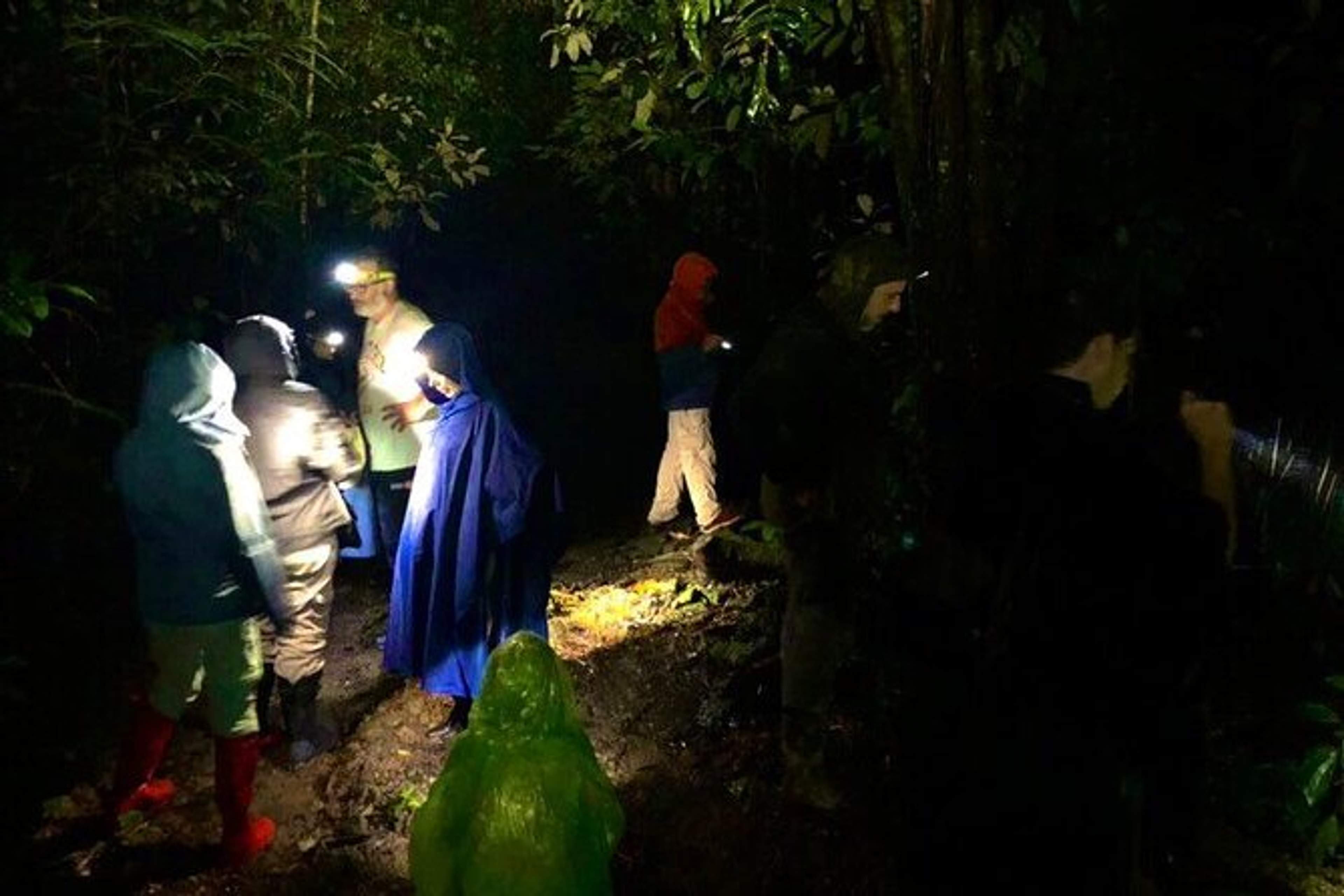
Sarapiquí's lowland tropical forest is one of the best places in Costa Rica to see nocturnal wildlife, and guided night tours are one of the most underrated experiences available to visitors. With a headlamp, rubber boots, and an expert naturalist guide, you walk slowly through the forest after sunset, and the guide's trained eye finds animals that you would never see on your own.
This is not a hike. It's a slow, quiet search, more like a treasure hunt where the prizes are alive.
Quick Facts
- Location
- Sarapiquí Xperience, 400 m south of Banco Nacional, La Virgen de Sarapiquí, Heredia.
- Guide
- Mandatory: authorized guide required
- Best Time to Visit
- Year-round, nightly; amphibian activity is highest in and after rain (green season, May–November).
What to Expect
What You'll See
A good guide makes all the difference. Experienced night-tour naturalists know where specific species live, which trees frogs prefer, where tarantulas build burrows, and what sounds to follow. They've walked these trails hundreds of times and know what's in residence.
Almost Guaranteed
• Red-eyed tree frogs, The Costa Rica poster animal. Emerald green body, vivid red eyes, blue-striped sides, orange feet. They sit motionless on leaves and are nearly invisible without a guide pointing them out. Seeing them in person, in the wild, is one of those moments that photographs can't capture.
• Poison dart frogs, Multiple species in Sarapiquí, some in brilliant blue, others in red and black. Tiny (thumbnail-sized) but unmissable in color. Found on the forest floor and low vegetation.
• Insects, Leaf-cutter ant highways, rhinoceros beetles, walking sticks, praying mantids, iridescent moths. The night forest is an entomologist's dream.
• Spiders, Including tarantulas. Your guide will find them in burrows or on tree trunks. Impressive when illuminated by headlamp.
Common
• Sleeping toucans, Keel-billed and chestnut-mandibled toucans sleep in tree hollows with their enormous bills tucked over their backs. Seeing a sleeping toucan is surprisingly moving, they look absurdly vulnerable.
• Snakes, Eyelash vipers (small, beautiful, yellow or green) coiled on branches. Boa constrictors draped in trees. Your guide spots them; you stay at a safe distance. Sarapiquí has venomous species, another reason a guide is essential.
• Bats, Multiple species hunting insects. Some guides carry UV lights to illuminate moths, which attract bats in real-time.
• Frogs, Beyond the red-eyed and dart frogs: glass frogs (translucent, you can see internal organs), smoky jungle frogs, masked tree frogs. Sarapiquí is a frog paradise.
With Luck
• Kinkajous, Nocturnal mammals related to raccoons, with golden fur and huge eyes. They move through the canopy at night feeding on fruit.
• Sloths, Two-toed sloths are primarily nocturnal and occasionally spotted on night walks.
• Owls, Several species call in Sarapiquí's forest. Heard more often than seen.
• Armadillos, Shuffling through leaf litter on the forest floor.
• Caiman, On tours near rivers or ponds, their eyes reflect red in flashlight beams.
The Experience
Format
Tours typically start at dusk (5:30–6:00 PM) and last 2–2.5 hours. You walk slowly, very slowly, through forest trails with a small group (4–8 people) and a naturalist guide. The guide carries a powerful flashlight or headlamp and knows exactly where to look: under leaves, in tree hollows, along branches, on the forest floor, in bromeliads.
What to Wear
• Long pants (tucked into socks or rubber boots, protects against brush and the occasional snake)
• Rubber boots, Most operators provide them. Essential on muddy forest trails.
• Long-sleeve shirt, Mosquitoes are active at dusk
• Closed-toe shoes if rubber boots not provided
What to Bring
• Headlamp or flashlight (most operators provide, but bring your own backup)
• Camera, Night wildlife photography is challenging but rewarding. A phone with night mode can capture frogs on leaves. A proper camera with flash produces stunning results.
• Insect repellent, Applied BEFORE the tour, not during (the scent can disturb animals)
• Rain jacket, Evening showers are common
• Water bottle
What NOT to Do
• Flash photography in animals' eyes (your guide will instruct on distance and angle)
• Touch any wildlife (poison dart frogs are toxic; snakes are snakes)
• Make loud noises (the quieter the group, the more you see)
• Wander off the trail (for safety and to avoid disturbing habitat)
Where to Go
Reserves and Lodges Offering Night Tours
Sarapiquí has several biological reserves and eco-lodges that run night walks:
• La Tirimbina Biological Reserve, Well-maintained trails, experienced guides, also offers chocolate tours. Near La Virgen de Sarapiquí.
• Selva Verde Lodge, Private rainforest reserve with night-tour program.
• Sarapiquí Rainforest Lodge, Frog-focused night tours in designated garden areas.
• Various independent naturalist guides, Bookable locally or through La Fortuna operators.
Cost
$30–55 per person for a 2–2.5 hour guided night walk.
Some tours are offered as add-ons to afternoon/evening lodge visits. Combo pricing may be available with safari floats or other Sarapiquí activities.
How to Combine with Your Trip
From Venecia/Bajos del Toro (35-50 min drive)
Afternoon → evening combo:
2:00 PM: Drive to Sarapiquí.
3:00 PM: Visit La Tirimbina Reserve (chocolate tour, hanging bridge, daytime trails).
5:30 PM: Night wildlife tour (2 hours).
8:00 PM: Dinner at a local restaurant. Drive back to Venecia.
From La Fortuna (75 min drive)
Full Sarapiquí day:
8:00 AM: Safari float (3 hours). Lunch.
2:00 PM: Explore La Tirimbina or Selva Verde.
5:30 PM: Night walk.
8:30 PM: Return to La Fortuna.
Combined with Rafting
The ultimate Sarapiquí day:
Morning: Whitewater rafting (Class III-IV, 3 hours).
Afternoon: Recovery, lunch, optional chocolate tour.
Evening: Night wildlife tour.
Three completely different experiences on one river corridor.
Why Sarapiquí for Night Tours
Night tours exist throughout Costa Rica, La Fortuna, Monteverde, Manuel Antonio. Sarapiquí's advantage is its lowland tropical wet forest, which supports some of the highest amphibian diversity in the country. The combination of warm temperatures, abundant moisture, and primary forest creates perfect conditions for frogs, which are the star attraction of any night tour. If you specifically want to see red-eyed tree frogs, poison dart frogs, and glass frogs in the wild, Sarapiquí is among the best locations in Costa Rica.
Frequently Asked Questions
Do you need a guide for a night wildlife tour in Sarapiqui?
Yes, a guide is essential. An expert naturalist knows exactly where to look, under leaves, in tree hollows, along branches, and finds animals you would never spot on your own. A guide is also a safety matter, since Sarapiqui has venomous species like eyelash vipers, and the guide keeps you at a safe distance.
How much does a night wildlife tour in Sarapiqui cost?
Expect to pay around $30 to $55 per person for a 2 to 2.5 hour guided night walk. Some tours are offered as add-ons to afternoon or evening lodge visits, and combo pricing may be available with safari floats or other Sarapiqui activities.
How long is the night tour and what time does it start?
Tours typically start at dusk, around 5:30 to 6:00 PM, and last 2 to 2.5 hours. You walk very slowly in a small group of 4 to 8 people with a naturalist guide, so it is a relaxed, unhurried pace rather than a fast hike.
What animals will you realistically see on a Sarapiqui night tour?
Red-eyed tree frogs and poison dart frogs are almost guaranteed, along with insects and spiders including tarantulas. Commonly you will also see sleeping toucans, snakes such as eyelash vipers, bats, and other frogs like glass frogs. With luck you might spot kinkajous, two-toed sloths, owls, armadillos, or caiman near water.
What should you wear and bring for a night wildlife tour?
Wear long pants tucked into your socks or boots, a long-sleeve shirt for the dusk mosquitoes, and rubber boots, which most operators provide, or closed-toe shoes if they do not. Bring a headlamp or flashlight as a backup, a camera, insect repellent applied before the tour rather than during, a rain jacket for evening showers, and water.
How physically demanding is the night wildlife tour?
It is not demanding. As the guide puts it, this is not a hike but a slow, quiet search, more like a treasure hunt where the prizes are alive. You walk very slowly through forest trails, so the main challenge is muddy ground, which is why rubber boots matter.
Where can you book a night tour in Sarapiqui?
Several biological reserves and eco-lodges run night walks, including La Tirimbina Biological Reserve near La Virgen de Sarapiqui, Selva Verde Lodge, and Sarapiqui Rainforest Lodge with its frog-focused tours. You can also book independent naturalist guides locally or through La Fortuna operators.
Good to Know
- Cell Service
- Available in La Virgen village.
- Payment
- Book ahead online with card; cash accepted on site.
- Accessibility
- Wheelchair and stroller accessible per the operator; not recommended for pregnant travelers or those with serious medical conditions.
- What to Bring
- Closed shoes or rubber boots (required), insect repellent, a rain poncho or umbrella, and a camera or binoculars; flashlights are provided.
Continue Exploring
More guides and resources to help you plan your trip