
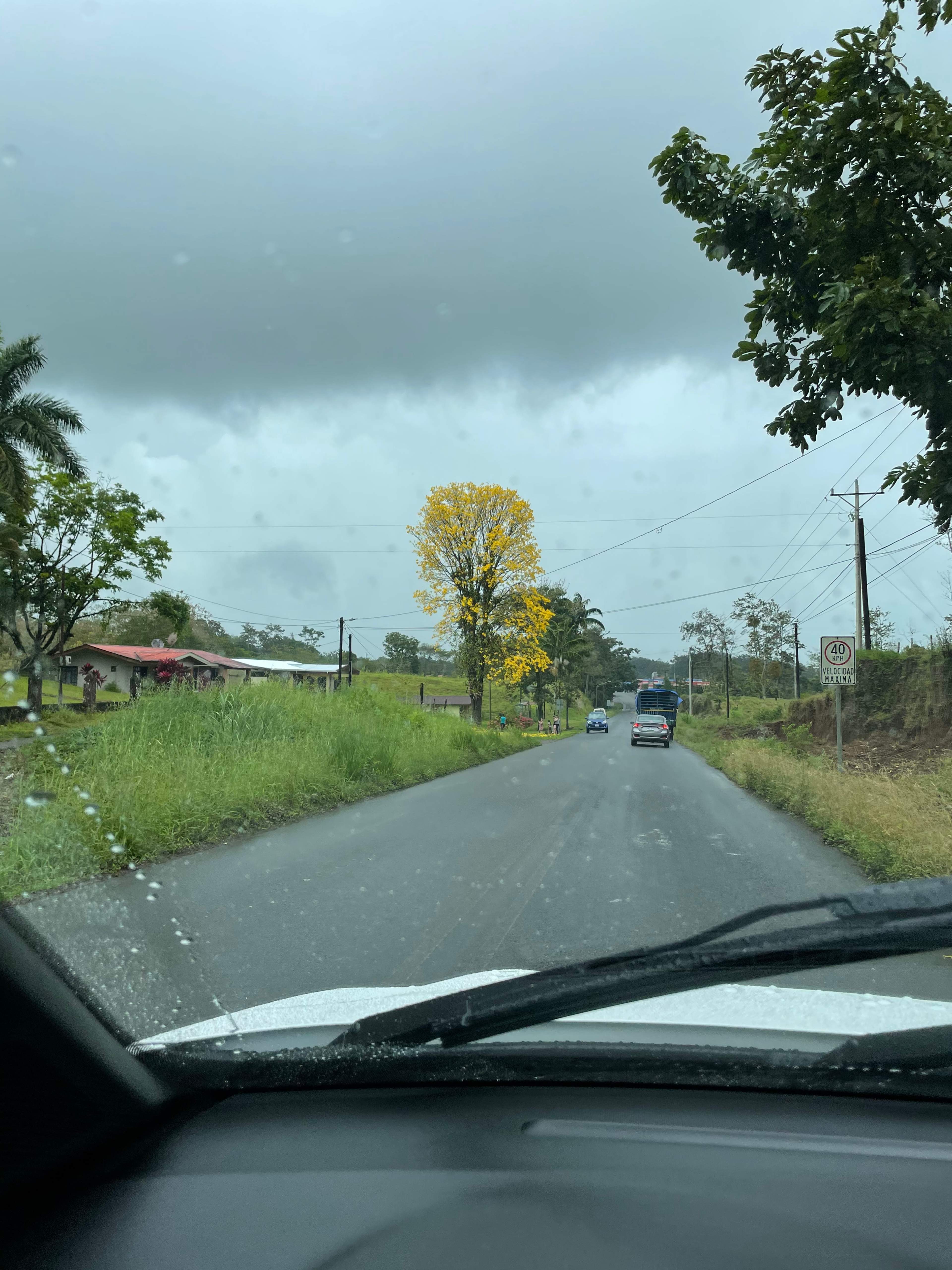
Everyone who rents a car in Costa Rica has the same experience: the first hour is terrifying, the second hour is stressful, and by the third hour you're driving like a local, honking at roundabouts, dodging potholes by instinct, and wondering why everyone told you not to drive here.
Driving in Costa Rica is not as dangerous as the internet suggests. It's also not as easy as the rental car companies promise. The truth is somewhere in between: the roads are manageable if you know what to expect, the rules are mostly the same as North America and Europe, and the independence a car gives you is worth every pothole.
This guide covers everything you actually need to know, from the insurance scam nobody explains to which navigation app actually works, from the roads that require 4WD to the ones Google Maps says are roads but aren't.
Should You Rent a Car?
Yes, if: You're visiting more than one region. You want to explore off-the-beaten-path. You're traveling as a couple or group (cost splits favorably). You value flexibility over convenience. You're comfortable driving in unfamiliar places.
Maybe not, if: You're staying in one location (beach town, eco-lodge). You're a solo traveler on a tight budget. You have significant anxiety about driving in new countries. You're only visiting San José and one other destination, shuttles may be cheaper and less stressful.
The honest math: A compact SUV rental costs $50–80/day base, plus $15–30/day for full insurance, plus $8–15/day in gas. Real cost: $75–110/day. For two people, that's $37–55 each. A shared shuttle between destinations costs $40–65 per person per ride. If you're making 3+ destination changes, the car wins on cost and crushes on flexibility.
Renting a Car: What They Don't Tell You
The Insurance Situation
This is the single most confusing and frustrating part of renting a car in Costa Rica. Here's how it works:
Mandatory liability insurance (SLI) is required by law and included in your rental rate from any legitimate company. This covers damage to OTHER people and their property. It does NOT cover your rental car.
Collision Damage Waiver (CDW) covers damage to the rental car itself. This is technically optional, but if you decline it, you're personally liable for the full value of the vehicle, which means the rental company will hold a $1,000–3,000 deposit on your credit card. One pothole, one rock chip, one parking lot scratch, and you're paying hundreds out of pocket.
The credit card insurance myth: Many travelers believe their credit card's rental car coverage works in Costa Rica. Some cards do cover CDW internationally (Chase Sapphire Reserve, some Amex Platinum), but the process is complicated: you must decline the rental company's CDW, the card company is the secondary insurer, and you may need to pay upfront and file a claim later. Many rental companies in Costa Rica push back against credit card coverage or require you to sign additional waivers. Check with your specific card before relying on this.
Our recommendation: Buy the full coverage from the rental company. It typically adds $15–30/day but eliminates all stress. You won't think twice about driving down a gravel road or parking in a tight spot. The peace of mind is worth more than the savings.
Choosing a Company
Reputable agencies: Adobe Rent a Car (Costa Rican company, good reputation, transparent pricing), Alamo, National, Budget, Avis, Hertz. Book through the company directly rather than third-party aggregators, it's easier to resolve issues.
Red flags: Extremely low daily rates ($15–20/day) that balloon with hidden fees at the counter. Companies that require cash deposits. Agencies that pressure you into unnecessary add-ons (GPS, roof racks, extra drivers at $10/day).
Book early in high season. December through April, SUVs and 4WDs sell out. Last-minute bookings during Christmas week can cost double or leave you with a sedan when you need a 4x4.
What Vehicle Do You Need?
Compact sedan (Yaris, Suzuki Swift): Sufficient for paved routes between major destinations: San José ↔ La Fortuna (paved), San José ↔ Manuel Antonio (paved), Pacific highway. Not suitable for Monteverde, Bajos del Toro back roads, Nicoya Peninsula dirt roads, or any route marked "4WD recommended."
Compact SUV (Tucson, RAV4, CR-V): The right choice for 90% of tourists. Handles gravel, potholes, steep hills, and the occasional water crossing. High enough clearance for dirt roads. Fits luggage for a couple or small family. This is what we recommend.
Full 4WD (Land Cruiser, Prado): For Monteverde via the unpaved route, Osa Peninsula, remote Nicoya beaches, or rainy-season back roads. Overkill for most standard itineraries. Costs $80–120+/day.
Automatic vs. manual: Specify automatic when booking. Many vehicles in Costa Rica are manual transmission, and you don't want to discover this at the counter after a red-eye flight. Automatic costs slightly more but saves you from clutch-work on mountain switchbacks.
Navigation: Waze vs Google Maps vs Intuition
This is the most practical section of this guide, and the one most travel blogs get wrong.
Waze: The Winner
Waze is the navigation app Costa Ricans actually use. It's crowdsourced, so it gets real-time traffic updates, accident reports, speed trap warnings, and road condition alerts from millions of local drivers. When a road floods or a bridge closes, Waze knows within minutes because locals report it.
Use Waze for: Real-time navigation while driving. Traffic avoidance in San José. Speed trap alerts (police checkpoints show up). Road hazard warnings. Directions to businesses and restaurants (Costa Ricans send Waze links for everything, your Airbnb host will send you one).
Google Maps: The Planner
Google Maps is better for trip planning, multi-stop routes, estimated drive times, satellite view of roads, and saving locations. But its real-time routing in Costa Rica is less reliable than Waze. Google Maps has been known to route drivers down roads that don't exist, send them on "shortcuts" through rivers, or underestimate drive times significantly.
Use Google Maps for: Pre-trip planning. Downloading offline maps (essential, do this over Wi-Fi for every region you're visiting). Checking satellite view to see if a road is paved or dirt before you commit. Finding businesses by name.
Apple Maps: Don't
Apple Maps doesn't work well in Costa Rica. Period. Don't use it for navigation.
The Golden Rule
Cross-reference Waze and Google Maps. Use Google Maps to plan your route, check satellite view for road conditions, and download offline maps. Then use Waze for real-time navigation while driving. If Waze suggests a route that looks weird on Google Maps' satellite view (unpaved, through a river, up a mountain), trust the satellite view and find an alternative.
Download Offline Maps Before You Go
This is non-negotiable. Cell coverage drops in cloud forests, mountain passes, national parks, and rural areas. Without offline maps, you're driving blind. In Google Maps: go to your profile → Offline Maps → select the region → download. Do this for every area you're visiting while on Wi-Fi. See our SIM Cards guide for full connectivity details.
The Roads: What to Actually Expect
Highways and Main Routes
Costa Rica's main highways are generally well-maintained and paved. The Pan-American Highway (Route 1/2), Route 27 to the Pacific coast, and Route 32 to the Caribbean are proper two-lane highways with painted lines, occasional passing lanes, and reasonable signage. Speed limits are 80–100 km/h (50–62 mph).
Routes between major tourist destinations are almost entirely paved:
• San José → La Fortuna: Paved the entire way (via San Ramón or Vara Blanca). 3 hours.
• San José → Manuel Antonio: Paved via Route 27. 3–3.5 hours.
• San José → Liberia: Paved via Pan-American Highway. 3.5–4 hours.
• San José → Bajos del Toro: Paved via Route 708 (Zarcero road). Beautiful drive. 2 hours.
• La Fortuna → Monteverde: Paved via the lake route (Arenal). 2.5–3 hours.
Secondary Roads
This is where it gets interesting. Secondary roads vary from "basically a highway" to "is this still a road?" Common features: single lane each direction, no painted lines, potholes ranging from minor to "that could swallow a tire," speed bumps with no warning, and bridges that are exactly one car wide.
Dirt and Gravel Roads
Several popular destinations require unpaved roads:
• Monteverde via the traditional route: Famously rough gravel road, ~3 hours of bumping. The newer route via Arenal is mostly paved and highly recommended instead.
• Nicoya Peninsula beaches (Mal País, Santa Teresa, Montezuma): Long stretches of dirt road, some with river crossings. 4WD recommended, especially in rainy season.
• Osa Peninsula (Drake Bay, Corcovado): Rough roads, river crossings. Full 4WD essential.
• Some accommodations and trailheads: Even in well-connected areas, the last kilometer to your hotel or a waterfall trailhead may be unpaved. Ask your accommodation about road conditions.
Night Driving
Avoid it if you can. Costa Rica's roads, even main highways, are poorly lit or completely unlit outside urban areas. Potholes that are manageable at 60 km/h in daylight become invisible hazards at night. Pedestrians, cyclists, and animals (dogs, cows, horses, the occasional coati) are on or near roads with no reflectors or shoulders. Fog is common in mountain areas after dark.
The practical approach: plan your drives so you arrive before sunset (around 5:30–6:00 PM year-round near the equator). If you must drive at night, slow down, use high beams when there's no oncoming traffic, and add 50% to your estimated drive time.
Driving Culture: How Locals Actually Drive
Honking is communication, not anger. A quick honk means "I'm here" or "go ahead" or "thanks." A long honk means "watch out." A friendly tap before a blind curve means "I'm coming around." Don't take honking personally.
Headlight flashes mean something. Oncoming drivers flashing their headlights often means "there's a police checkpoint ahead" or "slow down, something is on the road." Pay attention to this.
Passing is aggressive. On two-lane roads, locals pass on curves, on hills, and in situations that would cause cardiac arrest in North America. Don't do this. Just wait for a safe stretch. Trucks and buses will pull right to let you pass when it's safe, a quick flash of your hazards means "thanks."
Speed bumps appear without warning. Called "muertos" (dead men) or "policías acostados" (sleeping policemen). They range from gentle bumps to car-destroying ridges. Some are marked with signs or paint. Many are not. Slow down when entering any town.
Addresses don't exist. Costa Rica doesn't use street addresses. Directions are given as "200 meters north of the church" or "across from the red house." This is why GPS apps are essential. When searching for a destination, use the business name, not an address.
Police Checkpoints and Getting Pulled Over
You will encounter police checkpoints on Costa Rican roads. They're routine and usually uneventful.
What to expect: Officers wave you to slow down or stop. They may ask for your driver's license, passport (or a copy), and rental car paperwork. They'll check that the paperwork matches. If everything is in order, they wave you through. Total time: 30 seconds to 3 minutes.
What to have ready: Original driver's license (not a copy). Passport (original or a clear photocopy, keeping the original in your hotel safe and carrying a copy is common practice). Rental car agreement showing insurance. Keep these accessible, not buried in your luggage.
If you get a traffic ticket: Pay it through the rental car company or at a bank. Do NOT pay the officer directly in cash, that's a bribe, and while corruption exists, most Costa Rican police are professional. If an officer suggests an on-the-spot "fine" payable in cash, politely decline and ask for an official ticket ("multa oficial, por favor"). Legitimate fines are paid through the system, not on the roadside.
Speed traps: Exist, especially on main highways near towns. Waze will alert you. Speed limits are in km/h (60 in towns, 80–100 on highways). Fines can be steep, ₡55,000+ (~$110) for exceeding the limit by 20+ km/h.
Gas Stations and Fuel
All gas stations in Costa Rica are full-service. An attendant pumps your gas. You don't get out of the car. Here's the etiquette: pull up to the pump, turn off the engine, tell the attendant "lleno, por favor" (full, please) or specify an amount. Watch that the meter starts at zero before pumping begins. Pay in cash (colones or dollars) or credit card.
Gas prices are government-regulated. Every station charges the same price, there's no point comparing prices. As of early 2026, regular gasoline (super) is approximately ₡700–800 per liter (~$5.30–6.00/gallon).
Diesel vs. gasoline: Know which fuel your rental car takes BEFORE you fill up. A wrong fill can damage the engine and void your insurance. Most rental SUVs use gasoline (super). If in doubt, ask at the rental counter and check the fuel cap.
Spacing: Gas stations are plentiful along main routes and in towns. They're sparse in rural and mountain areas. Fill up before driving into Bajos del Toro, Monteverde, the Nicoya Peninsula interior, or any long stretch through forest or mountains. Don't let your tank drop below a quarter.
Key Routes for Wanderflow Regions
San José → Bajos del Toro (Route 708 via Zarcero)
Distance: ~85 km. Drive time: 2 hours. Road condition: Fully paved. Vehicle needed: Any car.
This is one of the most scenic drives in Costa Rica and one of the least known. You climb from the Central Valley through dairy country, pass through the charming town of Zarcero (stop for the topiary gardens, 10 minutes), then descend through cloud forest toward Bajos del Toro. The road winds through farms, forest, and mountain passes with views that rival any in the country.
La Fortuna → Bajos del Toro
Distance: ~60 km. Drive time: 1.5 hours. Road condition: Mostly paved, some sections may have gravel. Vehicle needed: Compact SUV recommended.
A beautiful route through the Northern Zone mountains. The road passes through agricultural land and cloud forest transition zones. Less trafficked than the main tourist routes.
Bajos del Toro → Venecia → La Fortuna
Distance: ~70 km. Drive time: 1.5 hours. Road condition: Paved. Vehicle needed: Any car.
The route descends from cloud forest through Venecia (a good base for the region) and continues to La Fortuna. This is the connection that makes combining Bajos del Toro waterfalls with La Fortuna volcano and hot springs easy.
Practical Checklist Before You Drive
• Book rental car (compact SUV, automatic transmission) at least 2 weeks in advance
• Confirm insurance covers full CDW, check credit card policy OR plan to buy at counter
• Download Waze and Google Maps
• Download offline maps for all regions you're visiting (on Wi-Fi)
• Get an eSIM or SIM card for data (see our guide)
• Bring your original passport + driver's license
• Get colones from ATM for gas, tolls, and parking
• Ask accommodations about road conditions for last-mile access
• Plan drives to arrive before sunset (~5:30–6:00 PM)
• Carry a phone charger cable for the car (navigation drains battery)
• Save your rental company's roadside assistance number in your phone
More practical guides for your trip:
• SIM Cards & eSIMs in Costa Rica, Stay connected on the road
• Costa Rica on a Budget, Transport costs, rental car pricing, and where to save
• Costa Rica Waterfalls: The 20 Best, Where to drive to, what to expect when you arrive
• The Complete Guide to Bajos del Toro, The scenic Route 708 drive ends here